
Choose by formula and launch plan, not by appearance alone.
Airless and traditional pump bottles can both deliver a professional skincare experience. The right choice depends on how much protection the formula needs, the desired dose, filling capability, order quantity and the experience your customer expects.
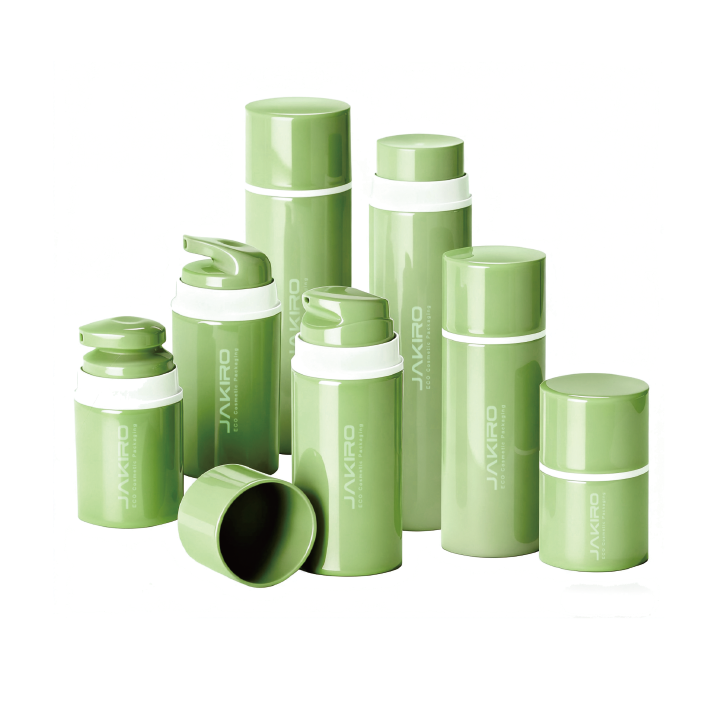
Choose airless when limiting air exchange, product evacuation and controlled dispensing are priorities. Choose a traditional pump when simplicity, familiar filling and broad component flexibility matter more. Test the complete package with the actual formula before committing.
What is the real difference?
A traditional cosmetic pump commonly uses a dip tube that reaches into the product. As formula leaves the bottle, outside air usually enters to replace the volume. An airless bottle uses a rising piston, collapsing pouch or related volume-changing system instead of a conventional dip tube.
Formula moves toward the pump
- No conventional dip tube
- Internal volume changes during use
- Designed to limit air replacement
- Requires system-specific filling and testing
The pump draws through a tube
- Uses a dip tube cut for the container
- Air commonly replaces dispensed product
- Familiar structure for many filling lines
- Broad bottle and closure combinations
Airless vs traditional pump bottle comparison
| Decision factor | Airless bottle | Traditional pump bottle |
|---|---|---|
| Dispensing mechanism | Piston, pouch or another volume-changing system | Usually a pump with a dip tube |
| Air exchange during use | Designed to limit replacement air | Outside air commonly enters the container |
| Product pickup | Formula is moved toward the pump | Dip tube must remain in contact with formula |
| Evacuation potential | Can reduce product left behind when properly matched | Residual product may remain around or below the tube |
| Orientation | Some systems support multi-angle dispensing; verify the model | Performance usually depends more on dip-tube position |
| Formula range | Can support many viscosities, but the exact pump must be selected and tested | Broad component choice; pump output and tube dimensions still require testing |
| Filling and assembly | May require bottom or top filling and model-specific procedures | Often familiar to contract fillers and standard pump lines |
| Component complexity | More integrated system; parts should be qualified together | Bottle, pump, tube and closure may offer more interchangeable choices |
| Cost direction | Often higher due to the complete dispensing system | Can be more economical, depending on material and decoration |
| Best reason to choose | Formula protection strategy and controlled use experience | Operational simplicity and flexible sourcing |
This table describes common tendencies, not guarantees. A premium traditional pump can outperform a poorly matched airless system. Likewise, one airless model may handle a formula that another cannot.
When should a brand consider airless packaging?
Sensitive positioning
The brand wants packaging designed to reduce repeated air exchange during consumer use.
Controlled daily dose
A repeatable pump action supports a serum, eye-care or treatment routine.
Reduced residue
The project values high evacuation potential and fewer awkward final uses.
Airless packaging is commonly considered for serums, essences, lotions, eye products and suitable creams. It can also support a more technical or treatment-oriented brand presentation. Still, an airless package does not replace formula stability, preservation or compatibility testing.
When can a traditional pump be the better choice?
- The formula does not require the additional dispensing architecture.
- The filler already runs a proven bottle, pump and dip-tube combination.
- The project needs broad bottle-shape, neck-finish or component flexibility.
- The launch budget prioritizes a simpler package.
- The product is used quickly or packaged in a larger personal-care format.
- The brand wants easy component replacement from multiple standard sources.
Choosing a traditional pump is not a compromise when it matches the formula and operation. The better package is the one that performs reliably through filling, transport, storage and consumer use.
Does an airless bottle cost more?
Airless systems often cost more than a basic pump-and-bottle combination because the dispensing mechanism and container work as an integrated package. The total commercial comparison should also include decoration, rejects, filling-line adjustments, freight, testing, product residue and the experience delivered to the customer.
Ask for a complete packed-product comparison: components, decoration, filling, assembly, quality testing, transport and expected order quantity.
Is airless packaging more sustainable?
Not automatically. Sustainability depends on material weight, number of materials, refill design, recycled content, local recycling infrastructure, product evacuation and the wider product system. Some suppliers offer mono-material or refillable airless designs, while other airless packs contain multiple materials that require separation.
The same caution applies to traditional pumps: a familiar bottle may have an established recycling pathway, while its pump can still contain mixed components. Assess the exact package rather than making a claim based only on the word “airless.”
A seven-question buyer checklist
- How sensitive is the formula to air exposure during repeated use?
- What viscosity and particle profile must the pump handle?
- What dose should one full actuation deliver?
- Can the contract filler run the selected system correctly?
- What starting quantity and customization level are realistic?
- How much product remains after a simulated use cycle?
- Does the total packed-product cost fit the brand’s price position?
Request samples of both formats when the decision is close. Fill them with the intended formula, evaluate priming and dispensing, and involve the formula developer and filler before final approval.
Frequently asked questions
Are airless bottles always better for skincare?
No. They can be valuable when the dispensing architecture supports the formula and brand objective. A standard pump may be more appropriate for straightforward formulas, larger volumes or simpler filling operations.
Can thick cream work in an airless bottle?
Some airless systems are designed for higher viscosities, but the answer depends on the specific pump path, dose, container and formula. Test the exact combination.
Does a traditional pump expose the entire formula to air?
Traditional pumps commonly allow replacement air into the container as product is dispensed. The degree of exposure and its relevance depend on the complete package and formula.
Can both formats be customized?
Yes. Color, spraying, printing, hot stamping and other decoration may be available for both. Feasibility and MOQ depend on the selected model and process.
Which format leaves less product behind?
A well-matched airless system can offer high evacuation, but actual residue depends on the formula, geometry and pump. Use an evacuation test rather than relying on a generic percentage.
Technical references
- Aptar Beauty: Five Key Advantages of Airless Packaging — airless mechanisms, dosage and formula-protection considerations.
- Aptar Beauty: Sirius Airless — an example showing how dosage, volume and viscosity are model-specific.
- Lumson: Airless Systems — examples of piston and pouch airless architectures.