
What happens when you press the pump?
An airless pump bottle dispenses product by creating pressure that moves a piston upward or collapses an inner pouch. The formula is pushed toward the actuator without relying on a dip tube or replacing each dose with outside air.
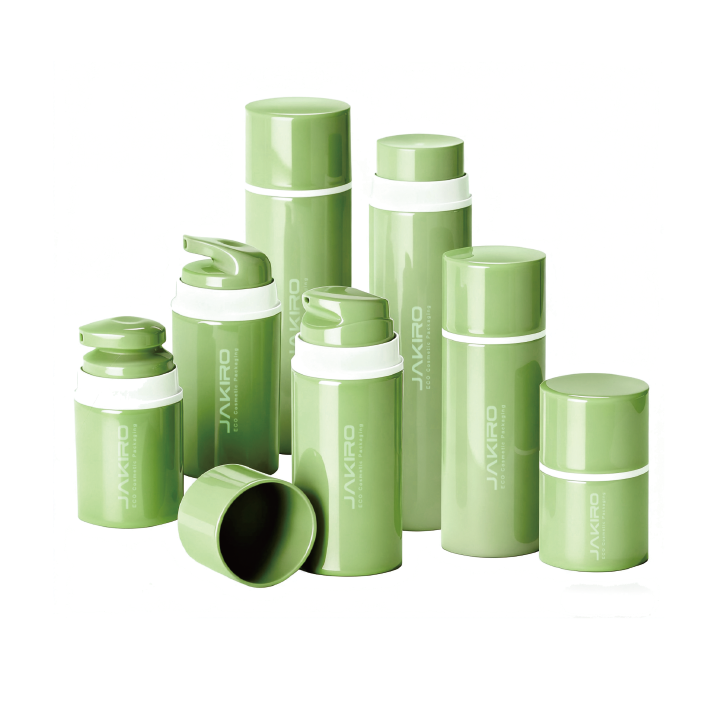
Short answer
Pressing the actuator creates a pressure difference. That movement draws the formula through the pump while the bottle’s piston rises, or its inner pouch contracts, to reduce the empty space left behind.
The dispensing cycle, step by step
A traditional lotion pump usually pulls product through a dip tube. An airless system uses a different internal path. Although exact components differ between manufacturers, the basic piston-style cycle can be understood in four stages.
The actuator is pressed
The user’s downward press activates the pump mechanism.
Product is dispensed
Pressure moves a measured amount of formula through the outlet.
Internal volume changes
A piston rises or an inner pouch contracts as product leaves the pack.
The next dose is prepared
The system resets for the next actuation without a conventional dip tube.
The first few presses may move air through the pump before product reaches the outlet. This is commonly called priming. The number of presses varies with the bottle, pump, fill level and formula.
It describes a dispensing system designed to limit air replacement and formula exposure during use. Performance depends on the complete package, filling process and formula compatibility.
Piston systems and pouch systems
Industry suppliers describe two common ways to change the internal volume as the product is dispensed.
Rising piston
A movable platform at the bottom travels upward as product is pumped out. The bottle normally has a small opening at its base so atmospheric pressure can act beneath the piston. That opening should not be blocked.
Collapsing pouch
The formula sits in an inner bag or pouch that contracts as it empties. The outer bottle provides the visible shape while the inner container changes volume.
Neither architecture is automatically better for every project. Bottle shape, material, dosage, decoration, formula behavior, filling method and recycling pathway all need to be evaluated at the specific-model level.
Airless bottle vs traditional pump bottle
| Decision point | Airless pump bottle | Traditional pump bottle |
|---|---|---|
| Product pickup | Rising piston or contracting pouch | Typically a dip tube extending into the formula |
| Volume replacement | Internal volume changes as product leaves | Outside air commonly replaces dispensed product |
| Orientation | Some systems may dispense in more orientations, subject to model and formula testing | Pickup generally depends on the dip tube remaining in product |
| Formula exposure | Designed to limit air entry during dispensing | More air exchange commonly occurs during use |
| Development work | Requires careful pump, formula and filling compatibility checks | Often familiar to fillers, but still requires compatibility testing |
What benefits can the mechanism provide?
The system can offer meaningful benefits, but responsible packaging selection avoids turning them into universal guarantees.
- Reduced air exchange during use: useful when a brand wants to limit repeated formula exposure after opening.
- More consistent product pickup: the changing internal volume helps move formula toward the pump rather than relying on a long dip tube.
- Potentially higher evacuation: industry suppliers report that well-matched piston or pouch systems can reduce formula left in the container. The actual result must be tested.
- Controlled dispensing: pump output can support a repeatable consumer routine when the selected dosage suits the formula and application.
- Packaging presentation: the outer bottle can offer a clean skincare appearance and broad decoration possibilities.
Airless packaging does not remove the need for stability testing, microbiological assessment or an appropriate preservation strategy. Those decisions belong to the formula developer and responsible testing partners.
Which formulas are commonly considered?
Airless bottles are frequently evaluated for serums, essences, lotions, eye-care products and suitable creams. Compatibility is not determined by the product name alone. Buyers should consider:
- Viscosity and how it changes across storage temperatures
- Particles, powders or ingredients that may affect the pump path
- Required dose per actuation
- Formula interaction with wetted materials
- Priming behavior and dispensing consistency
- Residual product after repeated use
- Leakage during shipping and storage
Very thick, highly particulate or otherwise challenging formulas may require a different pump, larger flow path or another packaging format. A supplier can help shortlist models, but the actual formula still needs testing.
How to prime and use an airless pump bottle
- Keep the bottle upright for the initial priming attempt unless the product instructions say otherwise.
- Press the actuator fully and repeatedly at a steady pace.
- Allow the actuator to return completely between presses.
- Once product appears, check whether each dose is consistent.
- Do not puncture or block openings at the base of a piston-style bottle.
If a filled bottle does not dispense, first confirm that it has been primed. Then check the actuator, product viscosity, fill condition and whether the pump has been assembled correctly. For a production project, recurring failures should be investigated through controlled compatibility and line trials rather than treated as a consumer-use problem.
What should a beauty brand test before ordering?
- Selected bottle, pump, actuator and overcap combination
- Formula compatibility with all product-contact materials
- Priming time and number of actuations
- Dose consistency through the intended use cycle
- Dispensing at expected storage and use temperatures
- Leakage and transport performance
- Product evacuation at the end of use
- Decoration adhesion and visual appearance
- Filling and assembly requirements with the chosen production partner
For Jakiro projects, the practical next step is to share the formula type, target capacity, estimated quantity and preferred finish. We can use those details to narrow the catalog before sample evaluation.
Frequently asked questions
Why is there no dip tube in an airless bottle?
The formula is moved toward the pump by a rising piston or contracting pouch, so a conventional dip tube is not required.
Why does a new airless pump need several presses?
The pump path may contain air before first use. Initial presses prime the mechanism by moving that air until formula reaches the outlet. The exact number varies by package and fill.
Can an airless bottle be opened and refilled?
Some models are designed for refilling or component replacement, while others are not. Do not assume refillability from appearance; confirm the structure and intended use of the specific model.
Does airless packaging mean preservatives are unnecessary?
No. Packaging can be one part of a formula-protection strategy, but preservation and safety decisions require professional formulation and testing.
Can an airless bottle dispense upside down?
Some airless systems can work in multiple orientations, but performance depends on the mechanism and formula. Test the exact model instead of treating this as a universal feature.
Technical references
- Aptar Beauty: Airless Packaging — piston and bag-in-bottle systems, formula protection and evacuation.
- Lumson: Airless bottle technology — overview of piston and pouch architectures.
- Lumson Airless portfolio — examples of pouch and piston packaging systems.